Braille building board: location and choice guide
A Braille plate for buildings helps blind people to identify by touching counters, elevators, toilets or stairs. The touch indicators come in sizes of 150x150, 200x100 or 300x100 mm. Find out what messages there are, where you place them, and what mistakes you avoid at the assembly.
In short: First mark the entrance, the counters, the toilets and the stairs, mount the plates by the door and check everything by touch.
Do you need help choosing?
Tell us what you need and we'll send you the offer on the same working day.
A Braille plate for buildings brings independence to visitors visually impaired people and order in orientation through the institution. Choose messages after the actual rooms, keep the same height on all floors and combine the plates with the touch marks on the ground. For location details, follow the accessibility project and applicable requirements, then check each plate by touch. Find all indicators in category Braille tactile markings.
A Braille plate for buildings allows blind people to identify by touch a door, a counter or an elevator. For them, the printed text does not help, but Braille points transmit the same information. Thus, orientation in the building becomes more independent and more secure. In addition, accessible signaling shows that the institution takes all visitors into account.
What a Braille plate contains for buildings
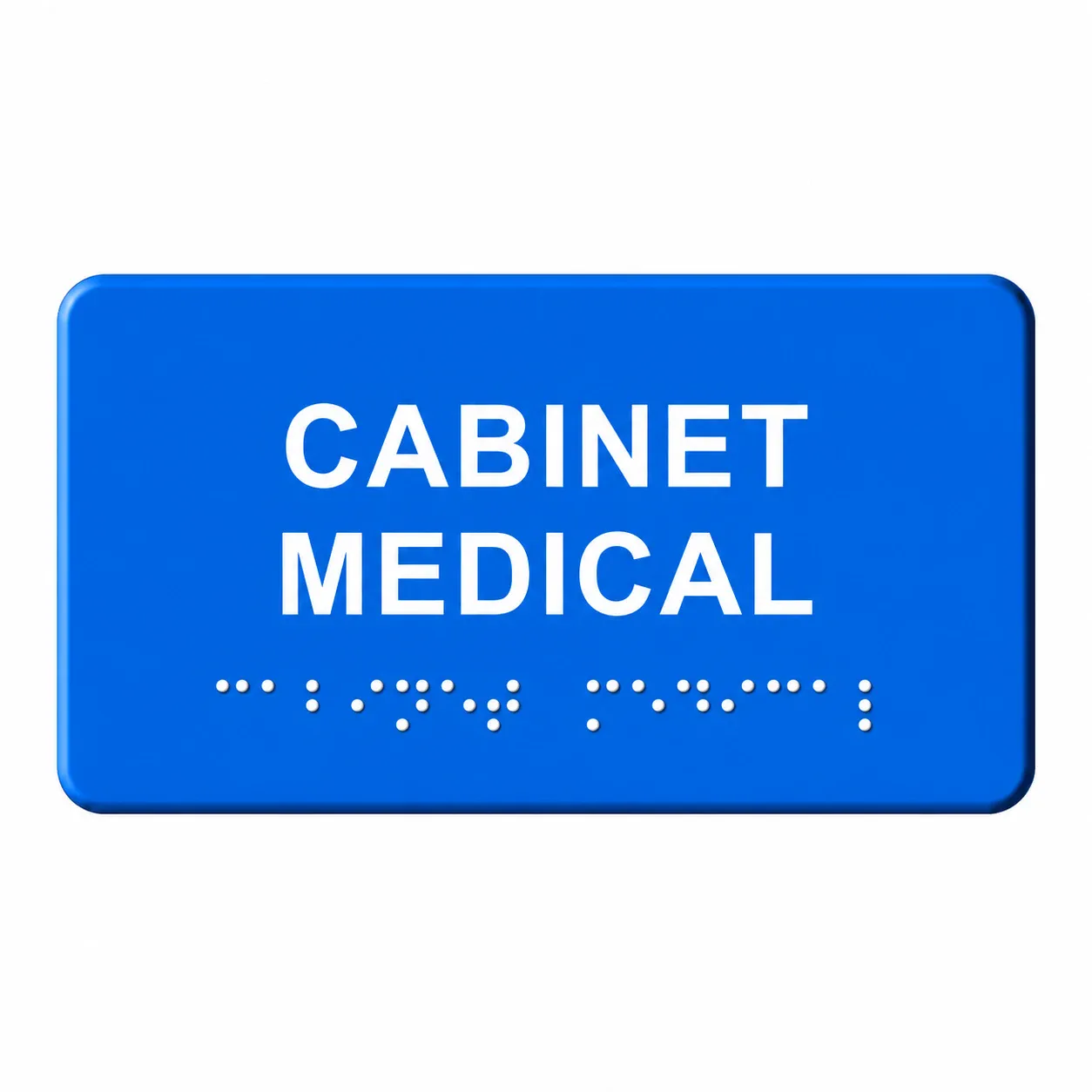
A good tactile indicator usually combines three elements. First, the message written, easy to read by those who see. Then the same message in the Braille alphabet. Finally, the contrast of color, useful to those who still distinguish shapes. Therefore, a Braille plate for buildings serves several categories of users at once. However, check in the file of each product which includes the chosen model.
Messages available for rooms and services
Category Braille tactile markings Find messages for the most visited areas of a building. For example, a Braille plate for public buildings may mark:
- Public services, such as Registration, Commission Guide, House or Secretariat.
- Vertical circulation, i.e. Lift and Evacuation Scarf.
- Facilities such as Toilet, in a 150x150 mm format.
- Offices, e.g. Chief Executive Officer or Public Procurement, in 200x100 mm and 300x100 mm formats.
- Safety areas, by means of the switch messages, and Point First Help.
Therefore, a Braille building board covers both the basic routes and the specific offices of an institution.
Where you place a Braille plate for buildings
The position matters as much as the message. A blind person looks for the plate with his hand, usually by the door, not the door. Therefore, mount the indicator on the wall at a constant height throughout the building. In addition, keep the space in front of the plate free of furniture or pots. Thus, a Braille plate for buildings remains easy to find at each door.
However, the exact location requirements shall be established by the project and the applicable regulations. Legal texts in force can be found on the portal legislatie.just.ro. Therefore, discuss with the designer before ordering a large number of indicators.
Formats and dimensions
The square size of 150x150 mm matches short messages such as Toilet. Instead, the rectangular formats of 200x100 mm or 300x100 mm accommodate longer names. For example, Public Procurement indicator has 300x100 mm. In other words, choose a Braille plate for buildings after the length of the text, not just after aesthetics. On the other hand, uniform formats on the same floor help the user anticipate where he finds the information.
How to plan a Braille plate for buildings on each floor
A simple plan avoids incomplete commands. First, take the sketch of each floor and mark all the doors used by the public. Then write down the exact name of the room next to each door. For example, an administrative floor may have a Registry, Secretariat Commission, Executive Director and Public Procurement. In addition, add the toilets, elevator and stairs, which are repeated on each level. Thus, the final list shows you how many plates you need from each message. In other words, each Braille building plate already has its place before the order.
Braille plate for buildings and escape route
Safety doesn't just hold desks and desks. For example, the Scara Evacuare indicator tactilely marks an important path in case of emergency. Also, the Turnout indicators and Point Prime Help show where the intervention equipment is. Especially in buildings with multiple levels, the tactile marking of the stairs matters for quick orientation. However, a Braille plate for buildings completes the usual security signal, does not replace it. The emergency evacuation and signalling plan shall follow the specific fire safety requirements.
Complete route: plates and markings on the ground
An unseen person reaches the door following a path. Therefore, the plates work best together with Touch markings On the floor. Thus, the ground marking leads to the door, and a Braille plate for buildings confirms the destination. In addition, the contrast between flooring and marking helps people with partial vision. It also retains the same location logic in all the premises of an institution. Thus, a Braille plate for buildings from another location becomes immediately familiar.
Frequent errors in mounting
- The plate stands on the door, and when the door opens, the message disappears.
- Height differs from floor to floor.
- The furniture blocks the hand access to the indicator.
- The text does not correspond to the actual name of the room.
So, take a tour of the building after assembly and check each plate by touch, with your eyes closed. Thus, a Braille plate for buildings proves its utility before opening to the public.
Frequently Asked Questions: Braille Building Plate
What rooms do I mark first?
Start with the entrance, counters, toilets, elevator and stairs. Then extend the mark to the offices visited frequently. Thus, cover from the beginning the routes that almost any visitor uses.
What size do I choose for a Braille plate for buildings?
For short messages, 150x150 mm. For long names, choose 200x100 mm or 300x100 mm.
Can I mount the plate on the door?
Usually, no, because the message disappears when the door opens. However, the final solution sets out the accessibility project.
Do they even fit in private buildings?
Yeah, like in offices or commercial spaces that get public. In addition, a Braille plate for buildings also helps occasional visitors who do not know the place.
Do plates help people with low vision?
Yes, especially when the written message has a good contrast to the background. Thus, the same Braille touch plate serves several types of visitors.
In conclusion, a well-located Braille building board turns an ordinary building into a more easy space for everyone. View all messages in category Braille tactile markings, and the Protrafic.ro team helps you choose the set according to your building.